Historical Materialism 2026 Cluj / Kolozsvár
Interregnum here & now: post-communist collapse, planetary crisis and emancipatory resolve
April 16-18, 2026
Since the first Historical Materialism Cluj / Kolozsvár conference in 2024, the polycrisis which was its main theme has not subsided. Instead, it has stabilized and deepened into a thick interregnum. We still face multiple, overlapping crises—economic, social, ecological, and geopolitical— yet these crises neither move toward resolution nor de-escalate. They persist, consolidate, and sediment themselves as the new normal.

Historical Materialism Cluj-Napoca 2024
Was organised by the Babeș Bolyai University, Historical Materialism journal, and tranzit.ro/Cluj as part of the PHILSE Project (Philosophy in Late Socialist Europe: Theoretical Practices in the Face of Polycrisis).
Historical Materialism Cluj 2024 Team
Siyaves AZERI | Stefan BAGHIU | Mihnea BÂLICI | Una BLAGOJEVIĆ | Liri CHAPELAN | Alex CISTELECAN | Ion COPOERU | Christian FERENCZ-FLATZ | Adela HÎNCU | Martin KÜPPER | Jan MERVART | Vlad POJOGA | Costi ROGOZANU | Leyla SAFTA-ZECHERIA | Ana SZEL | Adam TAKACS | Attila TORDAI-S. | Claudiu TURCUȘ | Ana ȚĂRANU | Monika WOŹNIAK
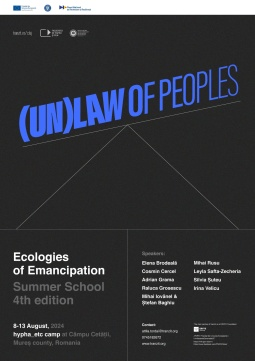
Summer School “Ecologies of Emancipation”, 4th edition
In the early 1990s, John Rawls outlined the theoretical foundations of a “realistic utopia” in The Law of Peoples — a vision of a liberal international order grounded in law, justice, fairness, human rights, and decency. Three decades later, much of that vision has eroded. Not only have its historical expressions faded, but even its ideological justifications have weakened.
Today, the liberal order often seems to justify genocide, fuel wars, and contribute to ecological and social collapse. Law, once seen as a tool for progress and emancipation, is increasingly used for repression and class domination — evident in anti-corruption campaigns and the rise of “rule by law.” At best, legal ideals are shelved for “better days,” while state violence fills the vacuum.
The fourth edition of the Ecologies of Emancipation Summer School seeks to examine this bleak moment through a critical history, sociology, and philosophy of law — from global treaties to local labor and reproductive rights — tracing their evolution and cultural and ideological implications.
The summer school “Ecologies of Emancipation” is organized by tranzit.ro/Cluj and the Faculty of Theatre and Film of the Babeș-Bolyai University within the project “Philosophy in Late Socialist Europe: Theoretical Practices in the Face of Polycrisis”.


